Engage Your Employees with Games
08/20/2015
Author: DeadreDiggs/Wednesday, August 19, 2015/Categories: Bulletin News
Remember when it was taboo to play solitaire on your computer at work? Well, did you know that Microsoft intended for online solitaire to be played at the office? It was designed to help new PC users get more comfortable with the Windows operating system. Solitaire is an early example of how “gamification” was used to solve a business problem. Today, gamification in the workplace is a much more sophisticated tool to engage and develop employees.
What gamers are telling corporate America
Gabe Zichermann, recognized gamification expert andauthor of The Gamification Revolution, says
“Gamification is the process of using game thinking and game mechanics to solve problems and engage users.”
Zichermann also believes that gamification is “a lot of design and a little bit of psychology. Akhil Tandulwadikar, Associate Research Manager at Cognizant Research Center and author of the Cognizant Reports, says this about using games to engage employees: “It should be understood at the outset that gamification is not about making games; it is about integrating game elements into existing processes.Gamification is a trend that is catching fire. Gartner, a leading information technology research company, predicts that, in 2014, more than 70% of Forbes Global
2000 organizations will have at least one “gamified application.
Get your game on
One example is the “My Work Community” portal used by LiveOps Inc., a call center company. My Work
Community featured missions for employees to complete around skills and how much time it takes to complete a call, as well as training and customer satisfaction. How successful was My Work Community? During the first week, 80% of LiveOps employees adopted the platform. And the adopters outperformed nonusers by 23%, with an average 9% higher rate of customer satisfaction.
 If you’re a Starbucks® regular, you may already be familiar with how gamification works. My Starbucks Rewards™ is a customer loyalty program that rewards consumers for buying Starbucks food, drinks and other products online or at a store. The more you consume, the more stars you collect, the more rewards you earn. You can also earn stars at affiliated retailers, such as Teavana®, and for buying Starbucks products at the grocery store.
What games could mean to your business
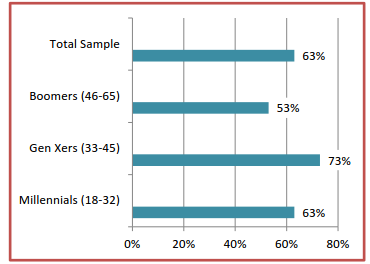
Millennials (ages 18–32) make up 25% of the workforce, and these employees live and breathe digital technology. They expect the online experiences of their personal lives to carry over to their work. That makes gamification a great way to engage this ever-growing population in the workforce. But it’s not just millennials who want to “play” at work. Gamification is being used at all levels and for all generations, including leadership training and internal communications.For example, research reported by Business Insider on February 5, 2014, shows that Generation X is even more into gamification than millennials. Here’s the breakdown of survey respondents who strongly agreed with this statement: “Making everyday activities more like a game would make them more fun and rewarding.”
What to know before you “gamify”
Here are some key lessons learned from companies that are using gamification in the workplace:
- Identify and articulate your business objectives first. Then determine how you’ll use a game to measure
progress toward the desired goal.
- Make sure the game design is intuitive. You don’t want to risk turning off your audience with a game that’s confusing or overly complex.
- Use games to improve behaviors, not disrupt routines. For example, a game designed for employee productivity should not be unwieldy and require cumbersome actions.
- Keep users engaged with meaningful rewards, variety and randomness; otherwise, the users will get bored.
Gaming for small businesses
Many game designers are entrepreneurs and small business owners themselves, so they understand the issues and challenges that smaller companies face. That makes them great partners if you’re considering adding gamification to your employee engagement resources, training programs and/or internal communications. It’s not the size of your company that matters; it’s the ability to understand how to take what’s fun about games and apply it to real-life situations.
Number of views (3994)/Comments (0)